Unsloth is an open-source AI platform for running and training open models locally. It combines Unsloth Studio, a graphical interface for running and training models, with Unsloth Core, a code-based library for fine-tuning and machine learning workflows. It supports language, vision, audio, embedding, and diffusion models across Windows, Linux, WSL, and macOS.
The project is particularly focused on making model fine-tuning more efficient by reducing memory usage and improving training performance. It can also run local models and connect them to coding agents and other tools.
Features
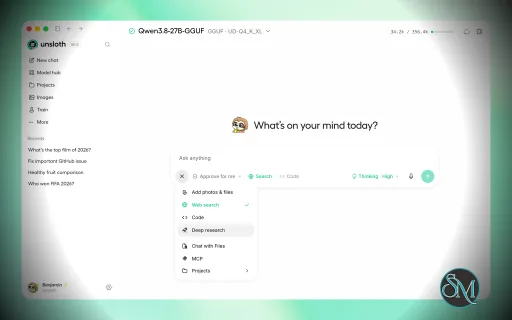
Unsloth provides a graphical environment for downloading, running, and training open models. Users can search for models, run them locally, fine-tune them, and export the resulting models to formats such as GGUF and safetensors.
Key features include:
Local LLM inference
LLM fine-tuning
Vision and multimodal models
Audio models
Embedding models
Diffusion models
GGUF support
MLX support
LoRA and other fine-tuning workflows
Model export
RAG
Web search
Tool calling
Code execution
MCP support
Multi-GPU support
Claude Code integration
OpenAI Codex integration
OpenCode integration
Docker support
Self-hosted web interface
Python API and notebooks
Unsloth Start can connect local models to supported AI coding agents, allowing tools such as Claude Code and Codex to use models running through Unsloth.
The platform also supports several hardware backends. The project lists NVIDIA, AMD, Intel, CPU, and Vulkan support, although capabilities differ depending on the hardware and workload.
Download Unsloth v0.1.915-beta - Software Mirrors |
|---|
Unsloth v0.1.915-beta for WindowsUnsloth-Desktop-Windows.exe | 20.66 MB Unsloth-Desktop-Windows-ARM64.exe | 20.04 MB |
Unsloth v0.1.915-beta for macOSUnsloth-Desktop-MacOS.dmg | 21.17 MB |
Unsloth v0.1.915-beta for LinuxUnsloth-Desktop-Ubuntu.deb | 22.54 MB Unsloth-Desktop-Ubuntu-ARM64.deb | 22.28 MB Unsloth-Desktop-Linux.AppImage | 169.56 MB |
Others Download related to Unsloth v0.1.915-betaUnsloth-Desktop-ARM64.app.tar.gz | 20.94 MB |
Unsloth v0.1.915-beta Source Code
Unsloth v0.1.915-beta Source code (zip)
Unsloth v0.1.915-beta Source code (tar.gz)
|
Unsloth v0.1.915-beta Release Notes: This release introduces Qwen3.8-Flash-Next, polishes the Glass themes (now in Beta), adds a Composer position slider and lets models interact with files in the built-in browser. It also brings lower idle memory usage, preserved chat context when switching GGUF models, faster MLX loading and FP8 LoRA training.
Highlights
- Qwen3.8-Flash-Next Dynamic V3.1 - 10-15% extra accuracy Guide
- Glass theme improvements across pages, menus, the sidebar and browser
- Browser file interaction lets models click, read and edit HTML, files and pages
- Lower idle memory with faster MLX loading and reloading
- Preserved chat context when switching between GGUF models
- FP8 LoRA training with lower GPU memory usage
- Composer position slider to place the chat box anywhere on new chats
Glass and appearance
- Set the chat box position, from top to bottom, in Settings > Appearance > Composer.
- Glass themes now have softer highlights, lighter shadows and improved frosted effects across menus, panels and the browser.
- Pages like Library, Images and Train no longer heavily blur background images.
- Open conversations now slightly dim the background and use denser glass for the composer.
- Windows and Linux title bars better match Glass themes and background images.
- Settings changes made in one browser tab now sync across other open tabs.
Built-in browser
- With Browser use enabled, models can click and type in HTML and React pages created in chat.
- Models can read and edit HTML, React, Markdown, code and text files directly in the browser. Back restores the previous version.
- Models can also read PDFs and other documents open in the browser.
- Download prompts can remember permissions per site or across all sites, including for program files.
Chat
- Chats now show activity between tool calls, including context compaction on GGUF models.
- Attach saved Library files using + > More > Attach from Library.
- Switching away from a GGUF model and back now preserves chat context, avoiding the need to re-read long histories.
- GGUF models can read up to four web pages at once when tools run without asking.
Connections and API
- OpenRouter models now load live, with working Reload models support.
- Improved compatibility with newer MCP servers.
- The Decision API adds LiquidAI's d1 models and Decider 2B (MLX only).
- Settings > API > Quickstart now includes curl, Python and JavaScript examples.
Performance and media
- Unsloth no longer loads PyTorch and other ML libraries at startup, significantly reducing idle memory usage. Configure startup features in Settings > General > Startup performance.
- MLX models load and reload much faster, and reducing a loaded model's context now takes seconds.
- Long prompts on supported MLX models use less memory.
- SDXL renders faster with very limited VRAM, including 4 GB setups.
- Image LoRAs in your model folders now appear on the Images page.
Training
- Faster, lower-memory LoRA training on 16-bit bases with recent NVIDIA GPUs using
float8_training = "fp8_lora".
- DPO, ORPO, KTO, GRPO and CPO training now run on MLX.
- Fixed crashes when full fine-tuning Gemma 4 in float16.
Trim overlapping highlight bulletsCombine related Glass bullets
What's Changed- Bump install.sh / install.ps1 pins to unsloth>=2026.11.1 by @danielhanchen in #16554
- Sync the pad id to FastModel's fallback tokenizer by @danielhanchen in #16557
- Studio: faster MLX load and reload, ready to serve when loaded by @Lyxot in #16536
- Parallel env tests: pin UNSLOTH_RETURN_LOGITS unset for the packing checks by @danielhanchen in #16594
- Tray status test: end the listener slice at its own close by @danielhanchen in #16600
- Studio: let managed accounts run terminal and Python tools on macOS by @NilayYadav in #16579
- Studio: fit reasoning_effort to a template's enforced allowlist by @Lyxot in #16527
- Kernels: name every tl.constexpr parameter with a trailing comment by @danielhanchen in #16585
- FP8 LoRA: fp8 forward and input gradient on the frozen 16-bit base by @danielhanchen in #16423
- Make startup ML warmup opt-in by feature by @Imagineer99 in #16469
- Kernels: keep per-call sizes out of the Triton compile key (layernorm dW, fp8 block matmul, nvfp4 split sum) by @danielhanchen in #16584
- Studio: stop browser panel pages typing stray control keys on macOS by @NilayYadav in #16583
- fix(studio): price MLX attention on the route the runtime takes by @Lyxot in #16517
- Studio diffusion kernels: keep per-resolution sizes out of the Triton compile key by @danielhanchen in #16582
- Scan baseline: re-review the five unsloth-zoo sites 2026.11.1 moved by @danielhanchen in #16624
- Context parallelism: generic Ulysses on any Hugging Face attention model, per-instance trainer wrappers by @danielhanchen in #16558
- Hide the sidebar footer fade only in glass themes by @Imagineer99 in #16572
- Fix duplicated wallpaper titlebar tint and modal dimming by @Imagineer99 in #16571
- Studio: fix external-server disconnects and show the server port by @oobabooga in #16595
- Fix glass surfaces in the built-in browser by @Imagineer99 in #16570
- FP8 rowwise scaled_mm: keep fp16 output in range before torch 2.14, and drop the row guard for always-dequant dtypes when compiled by @danielhanchen in #16598
- Multi-LoRA: export expert LoRA in the layout vanilla PEFT loads by @danielhanchen in #16568
- Studio: load OpenRouter models from the API by @NilayYadav in #16562
- Studio: read several web pages at once on local models by @NilayYadav in #16489
- Studio: keep profile and appearance changes made in another window by @NilayYadav in #16580
- Studio: scale spreadsheet figures in thousands or millions with decimals by @NilayYadav in #16590
- Studio: keep the MCP tool list steady between messages by @NilayYadav in #16488
- Studio: stop showing a cancelled tool request reply as finished by @NilayYadav in #16473
- Studio: keep chat context when switching models by @NilayYadav in #16493
- Studio: do not download PyTorch Clef for an over-long decision request by @NilayYadav in #16509
- Backend CI: run tensor and pipeline parallel gloo suites in separate shards by @danielhanchen in #16634
- Studio: keep image follow-ups running after the tab closes by @NilayYadav in #16491
- Studio: attach saved Library files to the current chat by @danielhanchen in #16522
- Forward the model argument through update_weight_conversions overrides (transformers 5.21+) by @danielhanchen in #16559
- Studio: keep long replies with escaped math streaming smoothly by @NilayYadav in #16490
- Studio: keep turn bookmarks made in another window by @NilayYadav in #16578
- fix(studio): reject ambiguous S3 audio references by @Max-Reisinger in #16529
- Studio: keep chat settings changed in another window by @NilayYadav in #16589
- Studio: list third-party image LoRAs from model folders by @NilayYadav in #16483
- Studio: ask Laya questions without instructions by their id by @NilayYadav in #16496
- Studio: open Try after Use in Decision API for Clef and LLM fine-tunes by @NilayYadav in #16497
- Studio: show status between tool rounds and while context compaction runs by @oobabooga in #16608
- Studio: let Laya fine-tunes answer from their GGUF export by @NilayYadav in #16511
- Studio: keep indentation in sent messages by @NilayYadav in #16495
- Studio: keep non-English text in structured Laya instructions by @NilayYadav in #16510
- Studio: move to mcp 2 and fastmcp 4 by @NilayYadav in #16475
- Studio: keep custom spellings when another window saves voice settings by @NilayYadav in #16577
- Studio: show how to call the Decision API from code by @NilayYadav in #16499
- Studio diffusion: show whether group offload keeps the transformer on the GPU or streams it every step by @oobabooga in #16610
- Studio: show the newest Kimi models in the model picker by @NilayYadav in #16591
- MLX: run DPO, ORPO, KTO, GRPO and CPO through trl, and stop blocking SFT arguments zoo honors by @Lyxot in #16461
- Studio: report bad decision datasets before the model downloads by @NilayYadav in #16498
- Studio: LiquidAI d1 and Decider decision models, train LFM3 into d1 by @Lyxot in #16519
- Studio: size streamed SDXL UNet leaves from the denoise peak and lend them to the VAE decode by @danielhanchen in #16620
- Diffusion tests: pin the NVIDIA-host spoof and assert ROCm keeps the stock path by @danielhanchen in #16609
- Studio: glass theme polish and a composer position slider by @shimmyshimmer in #16643
- Studio: show Run settings gear on every GGUF quant row by @shimmyshimmer in #16660
- Label the Glass theme as BETA by @Imagineer99 in #16642
- Studio: let browser use read, click and edit files in the browser panel by @shimmyshimmer in #16644
- Studio: remember download answers for a site or every site, programs included by @shimmyshimmer in #16658
- fix(studio): load the MLX training dataset before the model by @Lyxot in #16618
- Join the Windows glass sidebar and title bar over chat wallpaper by @Imagineer99 in #16641
- Block compile: checkpoint recompute reuses the forward graph (shared_kv_states, output collector) by @danielhanchen in #16596
- Studio: keep native tool calls in mixed ShareGPT chats and render null-content calls on Qwen3 by @danielhanchen in #16120
- Studio: check the weight index of a module path that only reads as the root by @danielhanchen in #16212
- feat(studio): price GLM-5.3-Flash oQ quants as unsloth-zoo loads them by @Lyxot in #16619
- Improve model-load error guidance and shorten failure notifications by @Imagineer99 in #16540
- Block Swap blocker: Qwen3.8-Flash-Next-FP8 can't train with offload_layers, its FP8 n-gram table loads without its weight_scale by @LeoBorcherding in #15632
- Legacy CLI: apply --chunk_size and --stride to a text file passed as --dataset by @vineethsaivs in #16424
- Model picker contracts: read the GGUF row and gear pins from variantSelectMeta by @danielhanchen in #16669
- Studio H3: release resident denoiser blocks' host copies and give the RAM to the conditioner by @danielhanchen in #16639
- Studio video: load a commit-pinned cached snapshot offline when refs/main is missing by @danielhanchen in #16640
- cuDNN SDPA: keep known-bad decode and NaN-dQ shapes off cuDNN before torch 2.14 / 2.15 by @danielhanchen in #15934
- Studio: let search_conversation find this turn's results on API providers by @danielhanchen in #16666
- Studio: MLX training from a saved adapter, Continued Pretraining, streamed and audio datasets, with exact resume by @Lyxot in #16622
- fix(studio): rewrite S3 audio paths in single-record JSON manifests by @Max-Reisinger in #16631
- Apply appearance contrast once per slider drag by @Imagineer99 in #16676
- Confine Windows glass wallpaper blur to the inner page pane by @Imagineer99 in #16671
- fix(studio): skip hidden HTML subtrees in RAG parsing by @LimbC-C in #16612
- Fused preference loss: fall back when a global forward hook is registered by @lonexreb in #15226
- Studio: remember thinking Off after eject by @Souravrajvi0 in #15093
- Studio i18n: translate the browser tool steps and program download prompts in every locale by @danielhanchen in #16677
- Studio: forward a request's other chat_template_kwargs to llama-server by @debojyoti-dev in #16567
- Studio: saving a preset no longer brings it back on the model it was tuned on by @roydonsequeira in #14603
New Contributors- @LimbC-C made their first contribution in #16612
Full Changelog: v0.1.914-beta...v0.1.915-beta |
Performance and Compatibility
Performance is one of Unsloth's main purposes. Its training optimizations are designed to reduce memory requirements and speed up fine-tuning compared with conventional training workflows.
Actual performance depends heavily on the model, quantization, GPU, available VRAM, dataset, batch size, and training configuration. The project supports multi-GPU setups and provides specialized guidance for newer NVIDIA hardware, AMD GPUs, Intel GPUs, and Apple silicon.
Unsloth Studio can run on Windows, Linux, WSL, and macOS. The project also provides native desktop packages for Windows, macOS, and Linux, while the Studio interface can be installed separately and accessed through a local web interface.
macOS users can run models through MLX and GGUF, while supported Apple Silicon systems can also perform training workflows. NVIDIA GPUs provide the broadest support for training workloads, while AMD and Intel support varies by backend and feature.
Because Unsloth works with local models, storage requirements can become significant. Model weights, datasets, checkpoints, caches, and exported models can consume substantially more storage than the application itself.
System Requirements
Unsloth does not have one fixed hardware requirement because different workloads have very different resource requirements.
Supported platforms include:
For the code-based installation, the current documentation uses Python 3.13 with uv for Linux, WSL, and Windows installations.
GPU training requires a compatible backend and sufficient memory for the selected model and training configuration. Larger models generally require more VRAM or system memory, while quantized models can substantially reduce the memory requirement.
Docker is also supported, with official images available for different environments and GPU configurations.
Pros and Cons
Pros
Free and open source
Local model inference
Fine-tuning support
Memory-efficient training optimizations
Supports multiple model types
GGUF support
MLX support
RAG capabilities
MCP support
Tool calling
Code execution
Multi-GPU support
Windows, Linux, WSL, and macOS support
NVIDIA, AMD, Intel, and CPU support
Apple Silicon support
Docker support
Desktop application
Web interface
Python-based workflows
Supports AI coding agents
Cons
Hardware requirements vary significantly by model
Large models require substantial VRAM or system memory
Training workflows can be technically complex
Different hardware backends do not provide identical capabilities
Model files and training datasets can consume considerable storage
Some advanced workflows require command-line or Python knowledge
How to Install
The simplest option is Unsloth Desktop. The project provides native packages for Windows, macOS, and Linux. Linux users can choose DEB or AppImage packages, while macOS and Windows have dedicated installers.
For Unsloth Studio, macOS, Linux, and WSL can use:
curl -fsSL https://unsloth.ai/install.sh | sh
Windows can use:
irm https://unsloth.ai/install.ps1 | iex
After installation, start the Studio interface with:
unsloth studio
The interface runs locally and can be accessed through a web browser.
For developers who prefer the Python package, Unsloth Core can be installed inside a virtual environment. The project currently recommends using uv to create the environment and install Unsloth with automatic PyTorch backend selection.
Docker is another option for users who prefer an isolated environment or need a reproducible setup.
Final Verdict
Unsloth is more than a fine-tuning library. Its current ecosystem combines local model inference, training, model conversion, RAG, tool calling, AI agents, and a graphical Studio interface into a single open-source platform.
Its biggest strength is flexibility. Users can start with the desktop application and local models, then move to Python-based fine-tuning or Docker when they need more control. Support for multiple hardware platforms also makes it useful across a wider range of systems, although the available capabilities vary between backends.
The main limitation is complexity. Unsloth is aimed at users working with local AI models rather than people looking for a simple chatbot. Model size, VRAM, training configuration, and hardware compatibility all have a significant impact on the experience.
Post a Comment/Report Broken Link: