FrostWire 7.1.3-build-336

FrostWire is a BitTorrent based client and media downloader available for Windows, macOS, Linux, and Android. It was originally built on the LimeWire codebase and later evolved into an independent project with its own development direction. FrostWire focuses on simplicity, speed, and transparency, making it accessible to both beginners and advanced users.

The software supports torrent downloads, magnet links, direct cloud downloads, and media streaming. Its open source nature allows users to trust the software and understand how it handles data and connections.

Donate

Download FrostWire Desktop FrostWire 7.1.3-build-336

Download From SourceForge

Download FrostWire Latest (Windows 64bit)

Download FrostWire 6.7.9 (Windows 32bit)

Download FrostWire Latest (Mac OS x86_64)

Download FrostWire Latest (Mac OS arm64)

Download FrostWire Latest (Linux x86_64 tarball)

Download FrostWire Latest (Linux arm64 tarball)

Download FrostWire Latest (Android 8+)

Download FrostWire From Github

Mac OS arm64 - frostwire-7.1.3-arm64.pkg (159.15 MB)

Mac OS x86_64 - frostwire-7.1.3-x86_64.pkg (160.91 MB)

Linux arm64 tarball - frostwire-7.1.3.arm64.tar.gz (168.48 MB)

Windows 64bit - frostwire-7.1.3.windows.exe (158.22 MB)

Linux x86_64 tarball - frostwire-7.1.3.x86_64.tar.gz (182.95 MB)

Android APK - frostwire-android-release-3.1.4-b775-plus.apk (78.49 MB)

FrostWire 7.1.3-build-336 Release Notes:

FrostWire 7.1.3: FrostWire gets its own network

FrostWire 7.1.3 is the first update most of you will get since 7.0.4 in April, and it carries the whole 7.1 series: 373 fixes, 68 new features and a new BitTorrent engine. The headline is IceBridge, a peer-to-peer network over UDP that can carry any protocol. Its first service lets FrostWire users search each other directly, with no website in between. image

By the numbers

Four releases (7.1.0, 7.1.1, 7.1.2 and 7.1.3) shipped between April and November, and 7.1.3 brings all of them to everyone who updates from 7.0.4.
  • Fixes in the changelog: 373
  • … of which UI freezes and stutters: about 140
  • … of which crashes and errors: about 25
  • … of which security hardening: 26
  • New features: 68
  • Third-party components updated: 10 (plus 4 developer tools)
  • GitHub tickets closed: 206 (88 UI freezes, 23 crashes, 22 found by fuzzing)
  • Commits: 2,740
  • Test classes (desktop, shared and Android): 44 → 629
  • Fuzz-testing harnesses for parsers of untrusted input: 0 → 42
The freeze and crash counts are grouped from the changelog's wording, so treat them as close, not exact.

IceBridge: a peer-to-peer network over UDP

IceBridge is a peer-to-peer proxy network that FrostWire users run together. It runs over UDP, signs every message, and doesn't care what it carries: every message names the protocol it belongs to, and each node advertises which services it offers, such as relaying messages for other nodes or answering searches. Search is the first service FrostWire builds on it; relay already runs, and more services can join without changing the network underneath. That matters because, until now, every FrostWire search went out to websites: torrent indexes, archives, SoundCloud. When one of them went down or blocked FrostWire, its results were gone. On IceBridge, FrostWire users search what the others are seeding, with no website in between. The goal is decentralization and censorship resistance. As the network grows and indexes enough fresh content, centralized torrent index sites become less and less necessary: the index lives on the computers of the people sharing, with no single site to block, seize or shut down.
  • Its own transport. IceBridge runs alongside FrostWire as a small helper process and talks to other nodes over rUDP, a reliable, authenticated protocol on top of UDP, built for this network. Traffic is signed but not yet encrypted; every node already has an X25519 key for the end-to-end encryption planned next. Nodes relay for each other across several hops, so two users who can't reach each other directly still can through the mesh. It splits large answers into pieces, retransmits what gets lost.
  • Every node has an identity. Each FrostWire install creates an Ed25519 key pair, and every request and answer on the network is signed with it. A node can't pretend to be another one or change someone else's answer on the way.
  • Your identity is yours to keep. Options → Identity shows your node ID and fingerprint, and backs the key up as a 24-word phrase, the same BIP39 standard Bitcoin wallets use. Restore it on a new computer and you keep your reputation on the network.
  • Found through the BitTorrent DHT. Nodes announce themselves on the DHT, the BitTorrent network's own distributed directory, so there is no central server to shut down. Computers on the same network also find each other directly, and a few dedicated IceBridge servers help new nodes get started.
  • Hardened before it shipped. Most of the 26 security fixes are here: signed handshakes that can't be replayed, rate limits and size caps on everything a stranger can send, an authenticated control port that only listens on your own computer, and no amplification tricks through relaying. Every identity must carry a small proof of work, so faking identities in bulk costs real computation, and peers you only heard about from another peer aren't trusted until your node checks them itself.
Tools → IceBridge Console shows the network live: a filterable event log, your IceBridge download and upload speeds, and a graph of the last five minutes.

IceBridge and the BitTorrent DHT: two networks, one job

FrostWire 7.1.3 combines two networks, each doing what it does best.
  • The DHT is the phone book. The BitTorrent DHT is the global directory every BitTorrent client already uses. Each FrostWire node signs a small record about itself (its public key, its role and the UDP port it listens on) and stores it in the DHT under its own key. Nodes also announce themselves on a few well-known DHT topics, so others find them without a central server, and nodes that share their library publish a short signed list of their torrents there too.
  • IceBridge carries the conversations. When a node finds another through the DHT, it opens an IceBridge connection over UDP, and both sides prove who they are with the same key they use in the DHT. Over these connections FrostWire sends keyword searches to the peers that hold the content, gets back results signed by those peers, browses the catalogs they choose to share and fetches .torrent files. Peers behind home routers are reached through relays.
The DHT can't answer a keyword search, and IceBridge doesn't need a directory server. Together they make torrent search with no single site to block or take down, and with fresh results, because peers only answer with torrents they are actively sharing. The full design, down to the bytes on the wire, is in the IceBridge white paper by Angel Leon.

Distributed search, karma and browsing a peer

When you search, FrostWire now also asks other FrostWire users on IceBridge, and their answers appear next to the web results as Distributed results.
  • What gets searched. Each node keeps a local index of the torrents it is actively seeding, including the names of the files inside them. A search for "readme.txt" finds a torrent that contains that file even when the torrent's own name doesn't mention it.
  • Seeding is publishing. What you share is what you publish: only torrents you are actively sharing, seeding them or downloading and uploading to their swarm, are served as search results, and torrents you stopped sharing never are. A new setup page explains this. Answering catalog listing requests is on by default and you can turn it off. With it on, other FrostWire peers can browse your shared torrents and interested third parties can index them.
  • Karma. When a download from a Distributed result finishes, your node endorses the peer that shared it, once per peer and torrent. Endorsements are signed, chained, limited per period and anchored to a Bitcoin block six blocks deep that two block explorers agree on. A peer's karma counts the endorsements it receives, weighted by how much your node trusts whoever gave them, and an endorsement only counts for a torrent that peer shared itself, so nobody can raise their own karma. Distributed results are ranked by the sharer's karma after seeds; a Karma column, hidden by default, shows it, and Options → Identity shows your own karma and your participation (the endorsements you've given). Karma is young: scores start small and grow as nodes see each other's endorsements, so treat it as a hint for now.
  • Browse a peer's shared torrents. A Distributed result from a peer that allows it shows a Browse Shared Torrents icon. It lists everything that peer is seeding, and you can download any of it straight from them.
  • icebridge:// links. Paste an icebridge:// link in the search box to browse a peer, send them a search or see their details.

A new BitTorrent engine

FrostWire 7.1.3 runs jlibtorrent 2.0.15.3, up from 2.0.12.7 in 7.0.4. jlibtorrent is FrostWire's open-source Java binding of libtorrent, the engine behind most BitTorrent clients. This one carries every libtorrent fix from 2.0.13 to the unreleased 2.0.16, and OpenSSL 4.1.0.
  • Safer downloads. libtorrent fixes for a data corruption bug in memory-mapped storage, short disk reads on Windows, trackers stuck after a pause, and DNS leaks of peer and tracker host names.
  • No more native memory leaks. Every torrent, magnet, resume file and DHT message jlibtorrent decoded used to leak a copy in native memory: 100,000 reads of a 13.5 KB torrent leaked 1.7 GB. That is now flat, and libtorrent objects FrostWire stops using are freed automatically.
  • Faster between Java and libtorrent. Data now crosses in one call instead of one call per byte: moving 1 MB into libtorrent went from 6 ms to 0.4 ms. Reading torrents, resume data and DHT items is faster and lighter.
  • BitTorrent v2. Torrents that use only the new v2 format keep the files you picked, survive a restart and show their real piece sizes. Hybrid v1/v2 torrents use one consistent hash everywhere.
  • Every name, every character. Torrents whose file names contain emoji or other characters outside the basic Unicode plane download with the right names.
  • Less clutter. The native library is unpacked once instead of on every start, and the 13–30 MB copies older versions left in your temp folder are deleted.

What it means for FrostWire and for BitTorrent

BitTorrent has always been decentralized at the download and centralized at the search: the swarm needs no server, but finding a torrent meant visiting a website. IceBridge closes that gap for FrostWire users.
  • Search that can't be switched off. Torrent sites come and go; this year alone FrostWire dropped Idope and added Bitsearch to keep results flowing. Distributed results come from users, through the DHT, with no site to block or take down.
  • Seeding becomes worth more. What you seed is what others find, and every finished download from you earns karma. Keeping a torrent alive now helps others discover it, not only download it, which is what keeps less popular content reachable.
  • Trust you can check. Answers are signed, reputations are built from signed endorsements, and nothing depends on trusting a central operator. A malicious node can lie about what it has, but it can't forge someone else's answer or reputation.
  • Better for everyone on BitTorrent. IceBridge results are ordinary torrents and magnet links, so the swarms they lead to include every BitTorrent client, not only FrostWire. The jlibtorrent fixes, memory leaks included, reach every app built on jlibtorrent.
  • One network across devices. The network code lives in FrostWire's shared core, the same code FrostWire for Android runs, so desktop and phone users search the same network.

Written 100% with AI

Every line of code in the 7.1 series was written by AI coding agents, directed and reviewed by the FrostWire team. Nothing here was typed by hand, and the commits show it: most of them name the model that wrote them. We used many models along the way: open-weight models such as DeepSeek V4.1, Kimi K3 and GLM 5.3, xAI's Grok, and OpenAI's GPT-6.1 Sol. In the last weeks most of the work was done with Anthropic's Claude Opus 5.5, the most capable model we've used. It solved every problem we gave it, from libtorrent's native memory leaks to the race conditions behind rare freezes.
  • Claude Opus 5.5 (Anthropic): 1,139
  • DeepSeek V4.1 Flash (open weights): 213
  • Grok 4.6 and 4.7 (xAI): 153
  • GPT-6 and GPT-6.1 Sol, GPT-6 Luna (OpenAI): 75
  • Claude Sonnet 5.5 (Anthropic): 38
  • Muse Spark 1.3 (via OpenCode): 35
Not every commit names its model, and some name more than one, so the table doesn't add up to the 2,740 commits. Kimi K3 and GLM 5.3 were used without a model line in the commit.

Smoother and steadier: the freeze and crash campaign

FrostWire 7.1 is far less likely to freeze, especially on older and slower computers. About 140 of the 373 fixes remove a freeze or a stutter. Since 7.1.0, FrostWire sends anonymous reports when its window stops responding for a few seconds or when it hits an error. The reports hold no personal data, only where in FrostWire's code the time went, the Java and OS versions and the memory in use. Each one became a GitHub ticket and a fix with a test that fails without it: 88 freeze tickets and 23 crash tickets closed since April. 7.1.3 also tells us which version it is and whether it hit an error during that run, so we can see which releases are the most stable; it identifies the run with a random number made at launch, never stored, and sends no installation or user ID.
  • Faster, steadier startup. The slow first-run work that used to freeze the setup wizard, the splash and the main window on 2-CPU Windows PCs now runs in the background, before the window needs it: fonts, menus, icons, layouts and FrostWire's own classes. The first search's buttons, the Dark and Light Flat themes, and the Library, Search and Transfers screens now load their parts at startup too.
  • No more waiting on the disk or the network in the window. Library folders on slow, network or sleeping drives, file icons from Windows and macOS, folder choosers, Explore and Open, adding, pausing and removing transfers, and saving settings all moved off the window's thread.
  • Sharper and lighter on Windows. Text is no longer blurry above 100% display scaling, FrostWire.exe is signed by FrostWire LLC, and it stopped forcing Java's OpenGL renderer, which made the window wait on the graphics driver.
  • More memory when you have it. FrostWire uses up to a quarter of your computer's memory instead of a fixed 512 MB (at least 512 MB, at most 4 GB).
  • Fewer crashes. Thousands of transfers no longer overflow the stack, sorting tables while they update no longer crashes, and Macs missing the Lucida Grande font start normally.
  • Hardened against bad files. 42 fuzz tests feed malformed input to the parsers that read downloaded files and network answers. They found crashes and runaway memory use in MP3, MP4 and search result parsing, all fixed.

Also new

  • Create Torrent, rebuilt. Drop a file or folder on the dialog, then set private torrents, a comment, tracker tiers, DHT nodes and file attributes, with a progress bar while pieces are hashed. Large folders no longer freeze it.
  • YouTube videos with sound. Video downloads now fetch the matching audio and merge it, and Telluride build 48 keeps YouTube and other sites working. On macOS, Telluride downloads now start instantly instead of taking about 9 seconds each time; only its first run after an update takes a few seconds.
  • Already downloading? You'll see it. Search results you already started downloading show a download arrow, even in later searches. FrostWire keeps no list of your downloads, only a fixed-size Bloom filter that can recognize a result but can't be read back.
  • Transfer Detail → Pieces: choose which pieces download first. Every piece of a torrent is a cube in the Pieces tab. Hover one to see its state, size, byte range, how many peers have it and the files it belongs to. Click or right-click a piece that hasn't downloaded yet to set its priority: Don't Download, Low, Normal or High. Pieces you skip turn red and high-priority pieces turn orange, so you can see at a glance what will come in first and what won't come in at all. Want to preview a video before the rest arrives? Set its first pieces to High. The General tab adds Check Local Data and per-torrent sequential download, and opening the details panel keeps the selected transfer in view instead of hiding it behind the panel.
!The Pieces tab: downloaded pieces in blue, a high-priority piece in orange, a skipped piece in red, and the priority menu open on piece #3
  • IP Filter. Block lists in P2P, DAT, CIDR and Hosts formats, gzip or zip, and blocking that actually blocks: a bug had been adding ranges as allowed.
  • Bitsearch joins the search engines; Idope, which stopped working, is gone.
  • AI agents. FrostWire's MCP server lets AI agents such as Claude, Grok Build and others search, download and manage IceBridge; it works with stricter agents and recovers from failed starts.

Updated components

Every installer bundles the latest Java runtime, OpenJDK 27.0.1.0.3. We moved to it as soon as it shipped, because it fixes the severe vulnerabilities in Oracle's October 2026 Java security advisory, so you don't need Java installed or updated yourself.
  • jlibtorrent (libtorrent): BitTorrent engine | 2.0.12.7 | 2.0.15.3
  • OpenSSL (inside jlibtorrent): Encryption for BitTorrent | 3.x | 4.1.0
  • OpenJDK: Bundled Java runtime | an earlier release | 27.0.1.0.3 (fixes this October's Java security advisory)
  • Telluride (yt-dlp): YouTube and other video downloads | build 44 | build 48 (yt-dlp 2026.10.26)
  • OkHttp: HTTP client for searches and downloads | 4.12.0 | 5.5.1
  • Netty: IceBridge networking | not used | 4.2.19
  • BouncyCastle: IceBridge identity cryptography | 1.83 | 1.86
  • SQLite JDBC: Local search index | 3.51.3.0 | 3.53.4.0
  • Gson: JSON for search results and settings | 2.13.2 | 2.15.0
  • FlatLaf: Dark theme | 3.7.1 | 3.7.2
For developers: Gradle 9.8.2, Spotless 8.10.4, JUnit 5.14.4 and google-java-format 1.36.1; FrostWire now builds on JDK 26 and later.

Get FrostWire 7.1.3

FrostWire 7.0.4 will offer the update when you start it, or you can download it now for Windows, macOS and Linux from frostwire.com/download. The full list of changes is in the changelog, and the code is on GitHub. Keep seeding: on IceBridge, what you seed is what other people find. Download FrostWire

Key Features of FrostWire

BitTorrent Client

FrostWire includes a full featured BitTorrent client that supports magnet links, torrent files, and decentralized trackers. Users can manage downloads easily with pause, resume, and priority controls.

Built In Search

The application offers an integrated search engine that helps users find torrents and media content without leaving the app. Search results are organized and easy to filter.

Media Preview and Streaming

FrostWire allows users to preview audio and video files before completing the download. This helps save time and storage by verifying content first.

Cloud Downloader

Users can download files directly from cloud storage services and HTTP links. This makes FrostWire useful beyond torrent downloading.

Bandwidth and Speed Control

The software provides detailed bandwidth management options. Users can limit upload and download speeds to avoid network congestion.

Cross Platform Support

FrostWire runs on multiple operating systems including desktop and mobile platforms. This allows consistent usage across devices.

Open Source and Ad Free

FrostWire is open source and does not include hidden trackers or forced advertisements. This makes it a trusted choice for privacy conscious users.

Media Player Integration

The built in media player supports common audio and video formats, allowing users to play files directly after download.

Benefits of Using FrostWire

Easy to Use Interface

The layout is clean and intuitive, making it suitable for new users while still offering advanced options for experienced users.

All in One Download Solution

FrostWire combines torrent downloading, cloud downloads, and media playback in one application.

Community Driven Development

Being open source, FrostWire benefits from community contributions and continuous improvements.

Free and Transparent

Users get full access to all features without licensing fees or feature restrictions.

Suitable for Multiple Use Cases

From media downloads to large file transfers, FrostWire adapts to various needs.

FrostWire remains a reliable and user friendly solution for file sharing and media downloads. With its open source foundation, cross platform support, and integrated tools, it offers a complete and trustworthy experience. For users who want a free, transparent, and capable torrent client with additional media features, FrostWire continues to be a strong and dependable choice.

FrostWire is a free and open source file sharing application that allows users to search, download, and stream content across multiple platforms. It is well known for its clean interface, strong community support, and cross platform compatibility. FrostWire is commonly used for peer to peer file sharing, media downloads, and content discovery while giving users full control over bandwidth and privacy settings.
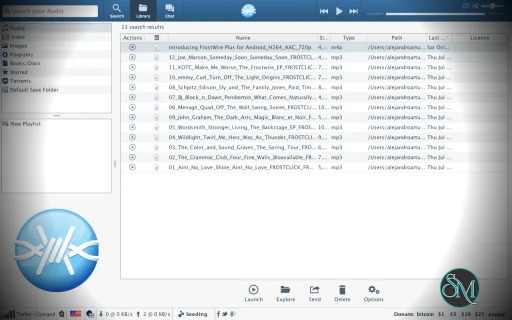
FrostWire 7.1.3-build-336
Free
Software Informations:
Developer:

Operating System:
Windows / Mac / Linux / Android
Date Added:
2026-11-08T10:07:17.329Z
Categories:

Post a Comment/Report Broken Link: