AdGuard for Windows is a system-level ad blocker that goes significantly beyond a conventional browser extension. It filters traffic from browsers and applications, blocks advertisements and trackers, provides DNS and HTTPS filtering, and includes additional privacy and security features. This makes it one of the most comprehensive ad-blocking solutions available for Windows.
Unlike browser-based ad blockers that only operate inside a particular browser, AdGuard for Windows operates at the system level. It can filter traffic from Chrome, Firefox, Edge, and other browsers as well as applications installed on Windows.
This is the main reason to choose the Windows application over simply installing an ad-blocking browser extension.
Key Features of AdGuard for Windows
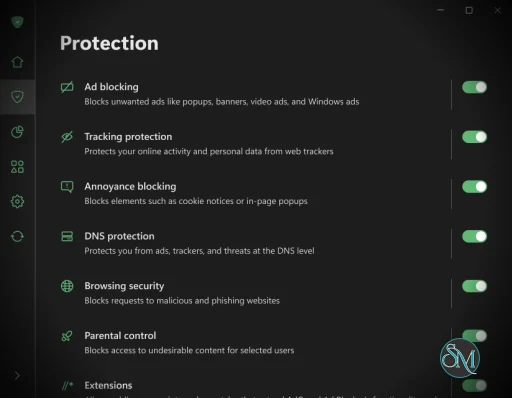
System-Wide Ad Blocking
AdGuard can block advertisements across the entire Windows system rather than limiting protection to web pages.
It can remove common advertising formats including banners, popups, video advertisements, and other web annoyances. Cosmetic filtering can also hide elements left behind after an advertisement is blocked.
This makes it particularly useful for applications that display advertisements through embedded web content.
Browser Protection
AdGuard works with virtually any browser without requiring a dedicated browser extension for basic filtering.
Chrome, Firefox, Edge, and other browsers can have their traffic filtered by the desktop application. AdGuard does provide a Browser Assistant extension, but it is primarily intended as a companion for controlling filtering directly from the browser.
HTTPS Filtering
One of AdGuard's more powerful capabilities is HTTPS filtering.
The application can decrypt HTTPS connections locally, inspect the traffic for advertisements and trackers, remove unwanted requests, and then establish the encrypted connection again. AdGuard states that the unencrypted content does not leave the device.
This allows filtering to work even when advertising and tracking requests are transmitted through encrypted connections.
However, HTTPS filtering requires AdGuard to install its own root certificate on Windows, so users should understand what this means before enabling the feature.
DNS Filtering
AdGuard can intercept DNS requests and block requests to known advertising and tracking domains.
It can also encrypt DNS traffic and provides advanced DNS configuration options, including DNS-over-HTTPS support and custom upstream DNS servers.
DNS filtering is useful because unwanted connections can be blocked before the application even establishes a connection to the advertising or tracking server.
Privacy Protection
AdGuard includes filters designed to block tracking systems, analytics, spyware, and other mechanisms used to collect information about browsing activity.
It also provides additional privacy controls beyond basic advertisement blocking.
Malicious Website Protection
AdGuard maintains a database of known malicious and phishing websites and can block requests to dangerous destinations.
This makes the application more than just an advertisement filter, although it should not be considered a replacement for a full antivirus or endpoint security product.
Application-Specific Filtering
Because AdGuard works at the system level, users can control filtering for individual applications.
This is useful when a particular application breaks because of filtering or when you only want AdGuard to operate on selected programs. The current Windows interface includes dedicated application management controls.
Custom Filters
Advanced users can add their own filtering rules and subscribe to additional filter lists.
This provides considerably more control than a typical "install and forget" browser extension.
Userscripts
AdGuard for Windows can also function as a userscript manager. Users can add and manage scripts, with automatic detection available for supported browser queries.
This adds another layer of customization for technically inclined users.
Download AdGuard Ad Blocker for Windows Latest Version
Download AdGuard Ad Blocker for Mac Latest Version
Download AdGuard Ad Blocker for Android Latest Version
Download AdGuard Ad Blocker for Android TV Latest Version
Download AdGuard Ad Blocker for iOS Latest Version
Download AdGuard Ad Blocker v8.0.4 - Software Mirrors |
|---|
AdGuard Ad Blocker v8.0.4 for Windows |
AdGuard Ad Blocker v8.0.4 Source Code |
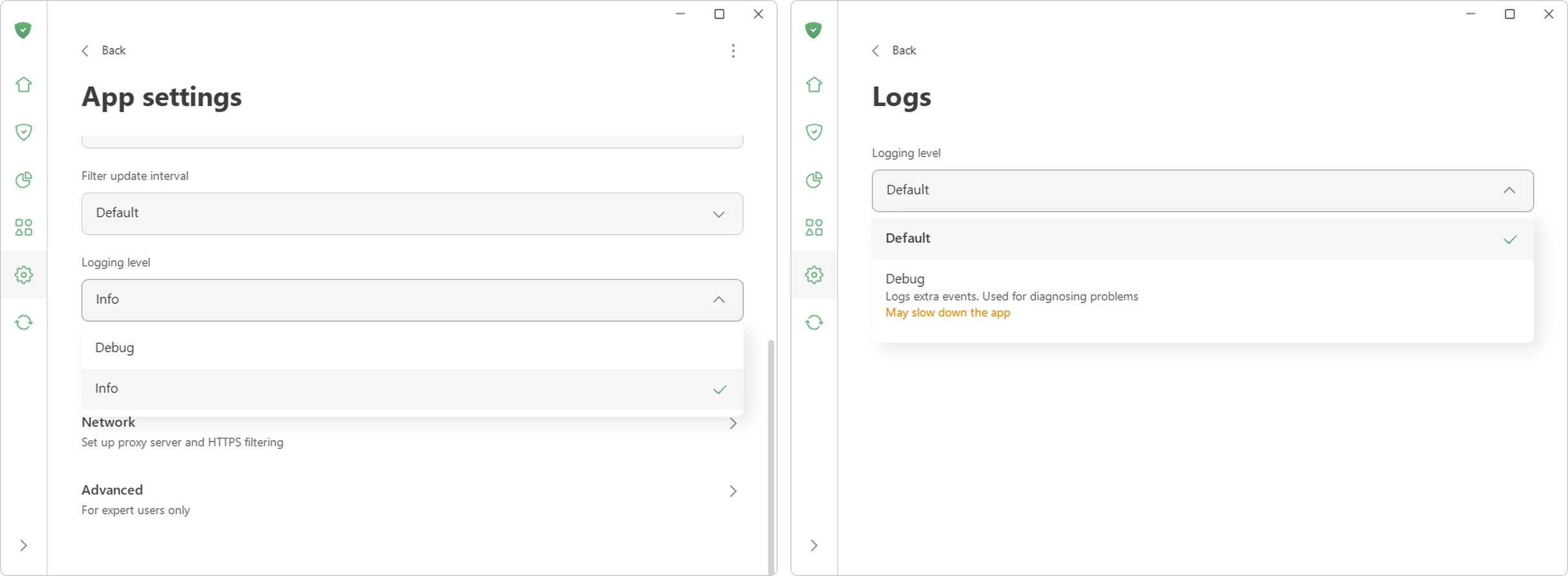
AdGuard Ad Blocker v8.0.4 Release Notes:Disclaimer AdGuard for Windows is not an open-source project. We use Github as an open bug tracker for users to see what developers are working on.In this patch, we’ve done quite a bit of work: added a couple of new settings, polished the UI, made the app more accessible, and fixed a lot of bugs related to the migration to v8.0, the filter editor, and localization. UIThe check for updates now runs every time you open the Updates tab, shows a Try again button if the check fails, and correctly reports if filters are up to date. Export logs and Logging level have moved to Support → Logs. We’ve also refreshed text styles and indents across the app and resolved several minor UI issues. !Logging level You can now navigate the app with your mouse’s back and forward buttons. In App management, apps that may have compatibility issues are now marked with a note, and the section remains fast even with a long list of apps.AccessibilityVoice output for inactive settings has been added across the Tracking protection, DNS server, DNS rules, User rules, Allowlist, and Blocklist* screens. Now, when protection is off, screen readers explain why a setting is inactive, and toggles are announced by name in the app’s language. Focus lands on the first element of every screen, screens can be opened with Space or Enter, and Escape reliably closes dialogs. The Hebrew interface now displays right-to-left correctly: the sidebar is on the right, the toggles are mirrored, and the divider between the sidebar and the selected tab is back. We’ll continue to improve RTL in future updates. Translations have been updated, and numbers in Statistics are now formatted correctly for Asian locales.New feature: ClientHello split!ClientHello split We’ve added a setting that gives you more control over connection handling. Specifically, it splits ClientHellos into two fragments. To choose the strategy that suits your needs, go to Tracking protection → Custom → Protect against DPI and toggle on ClientHello split. We do recommend you to read more about this feature in our knowledge base before enabling it. Using it without understanding how it works may break access to some unencrypted websites. Aside from adding a new feature, we removed the Block Flash setting from Tracking protection, added support for Quad9 to DNS-over-QUIC protocol, and updated the DNS provider catalog. We also added Blocking mode for DNS rules and updated DnsLibs and CoreLibs.Filter editor and extensionsIn this update, we fixed many issues in the filter editor and extensions that affected their proper functioning and caused the app to crash. We addressed null elements in the list, fixed errors in the processes of copying and pasting rules, as well as importing and exporting extensions and user scripts. The localization of warnings has been updated, and the app no longer crashes when adding or deleting rules in bulk.CompatibilityA lot of work was done to restore the functionality and, in some cases, broaden compatibility with platforms and tools like Ollama, pgAdmin 4, iCloud for Windows, and Windscribe. We also restored compatibility with several dozen games, including Dota 2, Roblox, Genshin Impact, and Call of Duty, and apps like Forza Horizon 6, Terraria, WeMod/Wand, Affinity Photo, and RStudio. The complete list can be found in the corresponding GitHub repository. Finally, we fixed an increase in CPU usage and a memory leak linked to login attempts into the Epic Games Store was fixed, as well as issues with compatibility with Kaspersky and Firefox apps.Stability and performanceWe increased the app’s stability and performance. Now, startup and sorting in Language-specific ad blocking are faster, and protection restarts smoothly. We fixed crashes that occurred during OS shutdowns and when running out of disk space while exporting logs.AdGuard for Windows vs BSOD errorsWe regularly update drivers to steadily reduce the number of BSODs users experience. If you encounter a “blue screen of death” error, please contact our support team and attach a minidump so that we can determine the cause. Read the dedicated Knowledge base article on how to create minidumps for reports. We appreciate every report because it is not always possible to test every existing system and application configuration. Thanks to your input, we can find and fix problems faster.ChangelogImprovements
Fixes
CoreLibs (Filtering engine)
DnsLibs (DNS filtering engine)
Sciter (UI engine)
|

Performance and User Experience
AdGuard's system-level approach makes it considerably more capable than a normal browser extension, but it also means the software is more deeply integrated into Windows.
The application uses a network driver to intercept traffic. When HTTPS filtering is enabled, it additionally installs a local root certificate to inspect encrypted connections.
For most users, this happens transparently in the background.
The advantage is that protection extends beyond the browser. The disadvantage is that system-level filtering can occasionally interfere with applications or websites that do not behave well with traffic interception. Fortunately, AdGuard provides application and network exclusions for troubleshooting these situations.
Advanced users will appreciate the extensive configuration options. Recent versions include detailed controls for DNS behavior, TLS handling, network exclusions, and filtering startup behavior.
Pros
System-wide ad blocking.
Works in browsers and applications.
Blocks advertisements, trackers, and annoyances.
HTTPS filtering.
DNS filtering.
Encrypted DNS support.
Phishing and malicious-site protection.
Application-specific filtering.
Custom filtering rules.
Userscript support.
Extensive configuration options.
Browser Assistant integration.
Regular filter updates.
Much more powerful than a basic browser extension.
Cons
More complex than a browser-only ad blocker.
HTTPS filtering requires installation of a local root certificate.
System-level filtering can occasionally cause application compatibility issues.
Uses a network driver.
Full functionality is not entirely free.
Some users may prefer the simplicity of a browser extension.
Who Should Use AdGuard for Windows?
AdGuard for Windows is particularly suitable for users who want system-wide advertisement and tracker blocking rather than browser-only protection.
It is also a strong choice for privacy-conscious users, people who regularly use ad-supported desktop applications, and advanced users who want detailed control over DNS, HTTPS, filtering rules, and individual applications.
If you only need to block advertisements while browsing the web, a browser extension is simpler and lighter. If you want filtering across the entire Windows environment, AdGuard for Windows is considerably more capable.
Final Verdict
AdGuard for Windows is one of the most comprehensive ad-blocking applications available for Windows.
Its biggest advantage is that it does not stop at the browser. By operating at the network and system levels, it can filter advertisements and trackers from browsers, applications, DNS requests, and encrypted HTTPS traffic.
The combination of content filtering, DNS filtering, HTTPS inspection, privacy protection, malicious-site blocking, application controls, custom rules, and userscript support makes it much closer to a local filtering platform than a traditional ad blocker.
The additional complexity is the trade-off. Users who only want basic browser ad blocking may find it excessive. For users who want comprehensive control over what their Windows machine communicates with, however, AdGuard is an excellent solution.
Developer:
Adguard Software Ltd.
Operating System:
Windows
Date Added:
2026-11-06T03:07:17.209Z
Categories:
Post a Comment/Report Broken Link: