RustFS is an open-source object storage system designed to provide S3-compatible storage for applications, backups, data lakes, AI workloads, and other large-scale data environments. Built in Rust, the project focuses on performance, memory safety, distributed deployment, and compatibility with existing S3-based applications.
It can run as a standalone server or as a distributed storage cluster, making it suitable for both smaller self-hosted deployments and larger storage environments.
Features
RustFS provides an S3-compatible API for storing and managing objects. It supports core capabilities such as uploads, downloads, bucket management, versioning, object locking, lifecycle management, event notifications, and server-side encryption.
The platform includes distributed storage, healing and background scanning, bitrot protection, pool expansion, bucket replication, and site replication. These features make RustFS more suitable for production object-storage deployments than a simple file server.
Security features include IAM policies, OIDC and SSO integration, server-side encryption, and a built-in key management system. RustFS supports Vault and AWS KMS backends for production KMS deployments.
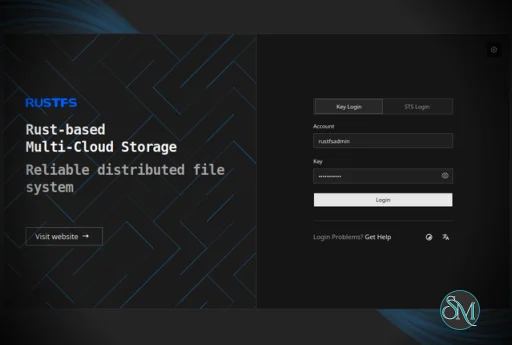
RustFS also includes a web-based management console for administration and object management. Kubernetes Helm charts are available for container-orchestrated deployments.
Beyond S3, RustFS provides additional protocols and integrations, including OpenStack Swift, Keystone authentication, SFTP, FTPS, and WebDAV. Some of these capabilities are enabled through optional build features.
Download RustFS 1.0.3 - Software Mirrors |
|---|
RustFS 1.0.3 for Windows |
RustFS 1.0.3 for macOS |
RustFS 1.0.3 for Linuxrustfs-linux-x86_64-musl-v1.0.3.zip | 97.2 MB rustfs-linux-x86_64-musl-v1.0.3.rpm | 96.49 MB rustfs-linux-x86_64-musl-v1.0.3.deb | 69.38 MB rustfs-linux-x86_64-musl-latest.zip | 97.2 MB rustfs-linux-x86_64-gnu-v1.0.3.zip | 109.88 MB rustfs-linux-x86_64-gnu-v1.0.3.rpm | 107.06 MB rustfs-linux-x86_64-gnu-v1.0.3.deb | 76.6 MB rustfs-linux-x86_64-gnu-latest.zip | 109.88 MB rustfs-linux-aarch64-musl-v1.0.3.zip | 89.38 MB rustfs-linux-aarch64-musl-v1.0.3.rpm | 89.16 MB rustfs-linux-aarch64-musl-v1.0.3.deb | 64.51 MB rustfs-linux-aarch64-musl-latest.zip | 89.38 MB rustfs-linux-aarch64-gnu-v1.0.3.zip | 106.37 MB rustfs-linux-aarch64-gnu-v1.0.3.rpm | 104.07 MB |
RustFS 1.0.3 Source Code |
RustFS 1.0.3 Release Notes:What's ChangedRustFS 1.0.3 keeps the 1.0.2 server code and updates the embedded Console to v0.1.37.
|
Performance and Compatibility
RustFS is built in Rust and is designed around high performance and efficient resource usage. Its distributed architecture allows storage capacity to scale across multiple nodes and drives.
S3 compatibility is one of its biggest advantages. The project maintains a compatibility matrix for supported S3 functionality, allowing users to evaluate whether their existing applications can work with RustFS. This is particularly useful for applications originally designed around Amazon S3 or other S3-compatible storage systems.
RustFS also positions itself as an alternative for MinIO deployments. However, compatibility should not be interpreted as complete drop-in compatibility. The project currently marks MinIO on-disk compatibility as preview functionality, and its documentation specifically notes that MinIO-encrypted objects cannot be read by RustFS. Existing MinIO installations should therefore be migrated through supported S3-based workflows rather than assuming the underlying storage can simply be reused.
The project supports both single-node and distributed deployments. Its documentation also places specific restrictions on topology expansion, so administrators should plan the initial storage layout carefully before building a cluster.
System Requirements
Linux or another supported platform capable of running RustFS
Docker, Podman, Kubernetes, or a supported native installation method
Storage capacity appropriate for the object-storage workload
Writable storage directories when using host-mounted Docker volumes
Additional resources for distributed deployments, replication, monitoring, and large workloads
For Docker deployments, the official container runs as the rustfs user with UID/GID 10001:10001. Host-mounted directories therefore need appropriate ownership or permissions.
Pros and Cons
Pros
Open-source under the Apache 2.0 license
S3-compatible object storage
Written in Rust
Supports standalone and distributed deployments
Web-based management console
Versioning and Object Lock
Bitrot protection and automatic healing
Bucket and site replication
Lifecycle management and remote S3 tiering
Server-side encryption and KMS integration
IAM policies and OIDC/SSO
Kubernetes Helm support
OpenStack Swift and Keystone support
SFTP, FTPS, and WebDAV support
Designed for AI, data lake, and high-throughput workloads
Suitable as a potential MinIO alternative
Cons
Still a relatively young project compared with established object-storage platforms
S3 compatibility is broad but not universal, so individual applications should be tested
MinIO on-disk compatibility is still marked as preview
MinIO-encrypted objects cannot be read directly
Distributed deployments require careful topology planning
Some protocols require optional build features
Large production deployments require proper planning for storage, networking, replication, and recovery
How to Install
RustFS provides several installation methods, including Docker, Docker Compose, native installation, Nix, and other deployment options.
For a simple Docker deployment, create persistent data and log directories, ensure they are writable by the RustFS runtime user, and start the official container with ports for the S3 API and web console.
After starting the service, the web console can be accessed through port 9001 while the S3-compatible service uses port 9000.
For production deployments, the official Docker Compose configuration provides additional observability components, while Kubernetes users can deploy RustFS using the available Helm charts.
When migrating from another S3-compatible platform, test the application's S3 API compatibility and use S3-based migration rather than relying on direct access to another product's underlying storage format.
Final Verdict
RustFS is one of the more interesting open-source alternatives for users looking for S3-compatible object storage outside the traditional MinIO ecosystem. Its Rust implementation, Apache 2.0 license, distributed architecture, encryption, replication, IAM, lifecycle management, and broad protocol support give it a strong feature set.
Its biggest advantage is that it is not merely a lightweight S3 gateway. RustFS aims to provide a complete object-storage platform capable of handling serious distributed workloads.
The main concern is maturity. Because the project is still developing rapidly, compatibility and operational behavior should be validated against the applications and storage topology you intend to use. MinIO users should also be particularly careful not to assume that existing on-disk data can simply be pointed at RustFS.
For new S3-compatible deployments, especially where an Apache-licensed and Rust-based storage platform is desirable, RustFS is a compelling option.
Post a Comment/Report Broken Link: