Jarvis is a local-first AI voice assistant designed to run on your own computer instead of requiring a cloud AI service. It combines speech recognition, local language models, speech synthesis, personal memory, voice conversations, and tool integrations in a desktop application. It can also work with text through its companion chat interface.
The project supports Windows, macOS, and Linux, and can use local model servers such as Ollama, LM Studio, oMLX, or llama.cpp.
Features
Jarvis is built around voice-first interaction. You can address it naturally during a conversation rather than having to formulate every request as a separate command. It keeps a temporary rolling transcript so it can use nearby conversation as context when responding.
The application provides local personal memory through a diary and knowledge graph. A Memory Viewer lets users inspect information stored by Jarvis, while sensitive information is redacted before being added to model context or saved diary entries.
Built-in tools include:
Web search
Weather information
Time information
Screenshot OCR
File access
Nutrition tracking
Optional location awareness
Personal memory
Local dictation
Text chat
MCP integrations
MCP support allows Jarvis to connect additional tools for tasks such as browser automation, smart home control, GitHub access, and databases.
The dictation feature can transcribe speech locally and paste the resulting text into other applications using a keyboard shortcut. Windows, macOS, and Linux use different default hotkeys, and some platform-specific limitations apply.
Download Jarvis v2.5.0 - Software Mirrors |
|---|
Jarvis v2.5.0 for Windows |
Jarvis v2.5.0 for macOS |
Others Download related to Jarvis v2.5.0 |
Jarvis v2.5.0 Source Code |
Jarvis v2.5.0 Release Notes:2.5.0 (2026-10-04)✨ Features🐛 Bug Fixes
⚡ Prerequisites
📦 Downloads
|
Performance and Compatibility
Jarvis performs its speech recognition, language model processing, and speech synthesis on hardware controlled by the user when configured with local models. It does not require a cloud AI account for normal local conversations. However, web search and connected integrations naturally require network access when those features are enabled.
Resource requirements depend heavily on the selected AI models, quantization, context length, and speech recognition configuration. The project provides smaller models for less powerful hardware and larger models for systems with more available memory.
The project is primarily developed on macOS, although packaged builds are provided for Windows and Linux. The developers note that behavior can differ between platforms.
Jarvis also includes a Low Power Mode that reduces background model activity. This can lower resource usage, although the first request after the models have been unloaded can take longer.
There are some current limitations. The global dictation hotkey is unavailable on macOS 26 and newer because of a pynput compatibility issue. Spoken commands such as "stop" can also occasionally be interpreted as echo while Jarvis is speaking. There is currently no mobile application.
System Requirements
Jarvis does not specify a single minimum RAM or GPU requirement because the requirements vary significantly with the selected local models.
Supported platforms include:
Windows x64
macOS Apple Silicon
macOS Intel
Linux x64
For local AI processing, available system memory and GPU or unified memory capacity become increasingly important as larger language models are selected. The project recommends smaller models for systems with limited hardware.
Users also need a microphone for voice interaction and sufficient storage for the speech recognition and language models.
Pros and Cons
Pros
Local-first AI architecture
No cloud AI account required for local conversations
Voice-first interaction
Personal memory
Local diary and knowledge graph
Local speech recognition
Local text-to-speech
Web search and other built-in tools
MCP support
Browser automation and other external integrations
Windows, macOS, and Linux support
Text chat interface
Local dictation
Low Power Mode
Open-source project
Cons
Requires significant hardware resources for larger local models
Initial model downloads can be large
Setup is more involved than using a conventional cloud AI assistant
Some features require additional dependencies or configuration
Platform behavior is not completely consistent
macOS 26 and newer currently have a dictation hotkey limitation
No mobile application
How to Install
Download the appropriate Jarvis package for your operating system from the project's GitHub Releases page. Windows provides an x64 package, macOS provides separate Apple Silicon and Intel packages, and Linux provides an x64 archive.
On Windows, extract the package and run Jarvis.exe.
On macOS, extract the application, move it to the Applications folder, then open it. The project notes that macOS users may need to right-click the application and choose Open during the first launch.
On Linux, extract the archive and run the Jarvis executable.
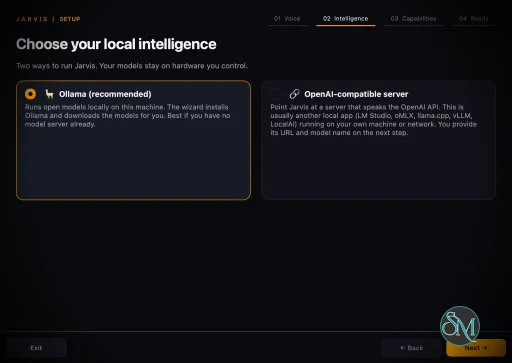
The setup wizard then guides you through selecting speech recognition and language models. Jarvis can use Ollama or an existing OpenAI-compatible local model server such as LM Studio, oMLX, or llama.cpp.
Allow microphone access when requested and wait for the initial model downloads to finish. The application provides logs and download progress information for monitoring the setup process.
Final Verdict
Jarvis takes a different approach from conventional AI assistants by making local processing the default. Its combination of voice interaction, personal memory, local models, dictation, built-in tools, and MCP support gives it a broad range of capabilities while keeping the core conversation data on the user's computer.
The main trade-off is hardware and setup complexity. Running speech recognition and capable language models locally requires substantially more resources than simply connecting to a cloud AI service. Model selection also has a direct effect on response quality and speed.
The project is particularly suited to users who want a desktop AI assistant with local processing and extensive tool integration rather than a simple chatbot. Its cross-platform support is useful, although some features and behavior vary between operating systems.
Developer:
Baris Sencan (isair)
Operating System:
Linux / Windows / macOS
Date Added:
2026-10-05T23:03:41.356Z
Categories:
Post a Comment/Report Broken Link: