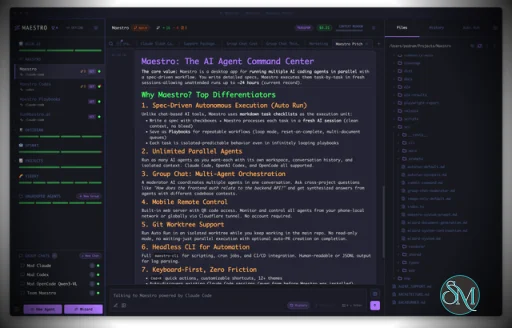
Maestro is a cross platform desktop application built to orchestrate multiple AI agents with isolated contexts. Each agent operates independently while still being managed under a unified command center. This allows users to execute complex workflows, parallel tasks, and long running processes efficiently.
The tool is open source and actively developed, targeting users who work with AI assisted development, research, automation, and experimentation.
Download Maestro v0.17.8 - AI Agent Command Center - Software Mirrors |
|---|
Maestro v0.17.8 - AI Agent Command Center for Windows |
Maestro v0.17.8 - AI Agent Command Center for macOSmaestro-0.17.8-x64-mac.zip | 219.55 MB maestro-0.17.8-x64-mac.dmg | 221.56 MB |
Maestro v0.17.8 - AI Agent Command Center for Linuxmaestro-0.17.8-x86_64.rpm | 129.1 MB maestro-0.17.8-x86_64.AppImage | 218.12 MB maestro-0.17.8-arm64.deb | 153.74 MB maestro-0.17.8-arm64.AppImage | 218.44 MB |
Maestro v0.17.8 - AI Agent Command Center Source CodeMaestro v0.17.8 - AI Agent Command Center Source code (zip) Maestro v0.17.8 - AI Agent Command Center Source code (tar.gz) |
Maestro v0.17.8 - AI Agent Command Center Release Notes:0.17.8 Highlights🔒 This is a security release, and every user should install it. Maestro runs a small built-in server somaestro-cli and the phone interface can drive the app. Until now that server listened on your whole network from the moment Maestro opened, even with Live off, and it answered requests from any web page. Anyone who got hold of its URL (someone on the same Wi-Fi while you used the phone link, a pairing link that leaked, or a web page that knew the URL) could run commands on your computer through it.
📡 The server now stays on your computer until you turn Live on. While the button reads OFFLINE it listens on 127.0.0.1 only, so nothing on your network can reach it, and maestro-cli works exactly as before. Turning Live on opens it to your LAN for your phone, and turning Live off closes it again with a fresh token. If a Persistent Web Link let you reach Maestro from your phone with Live off, turn Live on to use it now.
🛡️ Web pages can no longer drive Maestro, even with the URL. The server refuses any browser request from a page it did not serve itself, WebSocket connections included, so a malicious site that learns your link gets nothing back. The file maestro-cli reads its token from is now readable by your user account only.
Also in 0.17.8
|
Key Features
Maestro allows users to run multiple AI agents in parallel while keeping their context, state, and execution separated. This enables large tasks to be broken down and handled simultaneously.
The Auto Run and Playbook system lets users define workflows that execute steps automatically. These workflows can loop, batch tasks, or run unattended, making them suitable for long or repetitive operations.
Maestro supports group chat coordination where multiple agents collaborate within a single task. The tool handles routing and coordination to produce unified results.
Remote monitoring and control features allow users to observe and manage agent activity even when away from the main workstation.
A built in command line interface enables headless execution and scripting, allowing Maestro to integrate into broader automation workflows.
Ease of Use
Maestro is designed for users with technical experience. While it is not a beginner focused tool, its interface is structured for efficiency, especially for users familiar with development tools and multitasking environments.
Once configured, workflows are repeatable and easy to manage.
Performance and Compatibility
Maestro runs on Windows, macOS, and Linux. Performance scales based on system resources and the number of agents running concurrently. The application remains responsive even during complex orchestration tasks when used on modern hardware.
Because Maestro coordinates agents rather than performing heavy computation itself, overall performance largely depends on external AI services and configurations.
Pros and Cons
Advantages include powerful multi agent orchestration, parallel execution, automation through playbooks, command line support, and open source flexibility.
Limitations include a learning curve for new users, reliance on external AI models for functionality, and a focus on advanced workflows rather than simple chat usage.
Final Verdict
Maestro is a capable and thoughtfully designed orchestration tool for managing AI agents at scale. Its focus on parallel workflows, automation, and centralized control makes it a strong choice for advanced users working with AI assisted tasks.
For those who need structured AI agent orchestration rather than simple interaction, Maestro delivers a reliable and efficient solution.
Maestro is an open source agent orchestration tool that provides a centralized desktop environment for managing and running multiple AI agents and workflows simultaneously. It is designed for developers and advanced users who need structured coordination, parallel execution, and automation across AI driven tasks.
Maestro focuses on improving productivity when working with multiple agents by offering orchestration, monitoring, and workflow control from a single interface.
Developer:
Pedram Amini
Operating System:
Windows / macOS / Linux
Date Added:
2026-10-05T05:03:59.522Z
Categories:
Post a Comment/Report Broken Link: