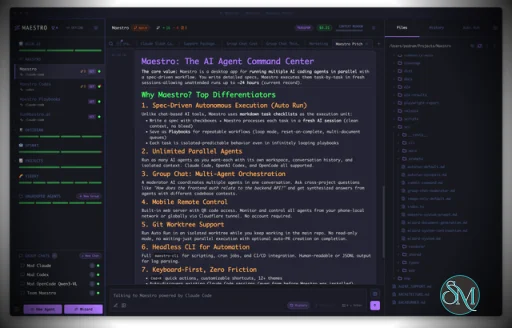
Maestro is a cross platform desktop application built to orchestrate multiple AI agents with isolated contexts. Each agent operates independently while still being managed under a unified command center. This allows users to execute complex workflows, parallel tasks, and long running processes efficiently.
The tool is open source and actively developed, targeting users who work with AI assisted development, research, automation, and experimentation.
Download Maestro v0.17.6 - AI Agent Command Center - Software Mirrors |
|---|
Maestro v0.17.6 - AI Agent Command Center for Windows |
Maestro v0.17.6 - AI Agent Command Center for macOSmaestro-0.17.6-x64-mac.zip | 219.5 MB maestro-0.17.6-x64-mac.dmg | 221.57 MB |
Maestro v0.17.6 - AI Agent Command Center for Linuxmaestro-0.17.6-x86_64.rpm | 129.07 MB maestro-0.17.6-x86_64.AppImage | 218.08 MB maestro-0.17.6-arm64.deb | 153.71 MB maestro-0.17.6-arm64.AppImage | 218.41 MB |
Maestro v0.17.6 - AI Agent Command Center Source CodeMaestro v0.17.6 - AI Agent Command Center Source code (zip) Maestro v0.17.6 - AI Agent Command Center Source code (tar.gz) |
Maestro v0.17.6 - AI Agent Command Center Release Notes:Major changes in 0.17.x🔍 Pan and zoom any diagram or image, full window. Mermaid diagrams and markdown images get an expand button, chat images open with a click, and anything else opens from its right-click menu with Expand (Pan and Zoom). Zoom at the cursor with the wheel or a pinch, drag or arrow-key to pan, double-click to fit, and diagrams stay vector-sharp however far you go in. Pinching an image in the file preview no longer zooms the whole window either. 📨 Send to Agent waits its turn. Handing context to a busy agent used to start it right on top of the running turn. It now opens a new tab and queues the context for when the current turn finishes, and with Forced Parallel Execution on, Force Send to Agent still runs it alongside. A dimmed Force Send also tells you why it is dimmed and takes you straight to the setting that unlocks it. 🍞 Toasts go where you want them and stay out of your way. Pick any corner in Settings > Notifications, or search Move Toast Notifications in Quick Actions. In a bottom corner they now lift above the message input, group chat included, instead of covering what you are typing. 🩹 The outage card tells the truth. It clears the moment a resend gets through, counts the retry that worked, and says "Quota restored." when it was your quota that came back. When a resend fails for a different reason, like an expired login, the card says auto-retry ended and names the real error instead of showing a green "Connection recovered." above it. 🗣️ Your agents can do more of Maestro for you.maestro-cli now starts and drives group chats, files feedback (searching for duplicates and adding a +1 first), writes a support package, flips any Cue subscription on or off, lists recent Cue runs, reads and redirects an agent's Auto Run, browses and installs from the Playbook Exchange, and queues audio or video in the player without starting it. A failing call now reports back right away instead of hanging until it times out.
Other Changes in 0.17.6
|
Key Features
Maestro allows users to run multiple AI agents in parallel while keeping their context, state, and execution separated. This enables large tasks to be broken down and handled simultaneously.
The Auto Run and Playbook system lets users define workflows that execute steps automatically. These workflows can loop, batch tasks, or run unattended, making them suitable for long or repetitive operations.
Maestro supports group chat coordination where multiple agents collaborate within a single task. The tool handles routing and coordination to produce unified results.
Remote monitoring and control features allow users to observe and manage agent activity even when away from the main workstation.
A built in command line interface enables headless execution and scripting, allowing Maestro to integrate into broader automation workflows.
Ease of Use
Maestro is designed for users with technical experience. While it is not a beginner focused tool, its interface is structured for efficiency, especially for users familiar with development tools and multitasking environments.
Once configured, workflows are repeatable and easy to manage.
Performance and Compatibility
Maestro runs on Windows, macOS, and Linux. Performance scales based on system resources and the number of agents running concurrently. The application remains responsive even during complex orchestration tasks when used on modern hardware.
Because Maestro coordinates agents rather than performing heavy computation itself, overall performance largely depends on external AI services and configurations.
Pros and Cons
Advantages include powerful multi agent orchestration, parallel execution, automation through playbooks, command line support, and open source flexibility.
Limitations include a learning curve for new users, reliance on external AI models for functionality, and a focus on advanced workflows rather than simple chat usage.
Final Verdict
Maestro is a capable and thoughtfully designed orchestration tool for managing AI agents at scale. Its focus on parallel workflows, automation, and centralized control makes it a strong choice for advanced users working with AI assisted tasks.
For those who need structured AI agent orchestration rather than simple interaction, Maestro delivers a reliable and efficient solution.
Maestro is an open source agent orchestration tool that provides a centralized desktop environment for managing and running multiple AI agents and workflows simultaneously. It is designed for developers and advanced users who need structured coordination, parallel execution, and automation across AI driven tasks.
Maestro focuses on improving productivity when working with multiple agents by offering orchestration, monitoring, and workflow control from a single interface.
Developer:
Pedram Amini
Operating System:
Windows / macOS / Linux
Date Added:
2026-10-03T02:29:23.275Z
Categories:
Post a Comment/Report Broken Link: